


How Mirador Analytics made client billing accurate with TimeCamp
Mirador Analytics needed to improve its hourly billing, as consultants sometimes worked beyond expected hours. By using TimeCamp to track work hours, Mirador achieved more accurate billing, increased client satisfaction, and streamlined timesheet submissions and meeting planning.



Who Mirador Analytics is
Mirador Analytics specializes in analyzing the risk of data disclosure in healthcare. They offer advice, statistical analysis, and their own automated solutions to help healthcare organizations show that people's records are de-identified enough to keep their privacy safe. Around 60 employees support clients throughout the de-identification process, alongside legal and privacy teams. In November 2021, Mirador Analytics was acquired by Datavant, the leader in data logistics for healthcare.

Industry: Data protection for healthcare

Employees: 50-99

Location: United Kingdom

Using TimeCamp: For project time tracking
Most-used features
- Customizable time views
- Project structures
- Google Calendar integration
- Custom reports


Results with TimeCamp

Positive feedback
lots received

Daily time savings
on filling up timesheets

No data lost
due to being offline

Emma Playford
Head of Client Management, Mirador Analytics
“I love the customizable time view: this allows us to track client hours used to their contractual agreements, as well as to provide our clients with an overview of how time is spent across their ongoing projects. We can also see how client hours fluctuate month-to-month, which allows us to better pre-emptively plan resource assignments. The whole system is user-friendly and easy to navigate around, even for new starts.”
The billing problem Mirador couldn’t prove to clients
Each month, Mirador assigns a set number of hours to each client. But when consultants exceeded those hours, they had no way to communicate the need for extra payment or prove it was necessary.
| Before TimeCamp | After TimeCamp |
|---|---|
| First tracker too complicated for employees | Easy setup, smooth implementation |
| Timekeeping tiring and error-prone | Project structures per client or task |
| Data lost when the internet went down | No data lost, even offline |
| UI built for managing projects, not tracking time | Custom views showing time per project and per staff |
| Couldn't prove extra hours to clients | Accurate client billing |
| Billable and non-billable work hard to separate | Billable and non-billable split on performance reports |
| Before TimeCamp |
|---|
| First tracker too complicated for employees |
| Timekeeping tiring and error-prone |
| Data lost when the internet went down |
| UI built for managing projects, not tracking time |
| Couldn't prove extra hours to clients |
| Billable and non-billable work hard to separate |
| After TimeCamp |
|---|
| Easy setup, smooth implementation |
| Project structures per client or task |
| No data lost, even offline |
| Custom views showing time per project and per staff |
| Accurate client billing |
| Billable and non-billable split on performance reports |
How TimeCamp separated billable from non-billable work
Mirador wanted a tracker that separates in-house projects and trainings from client work, so managers could tell billable from non-billable work on performance reports.
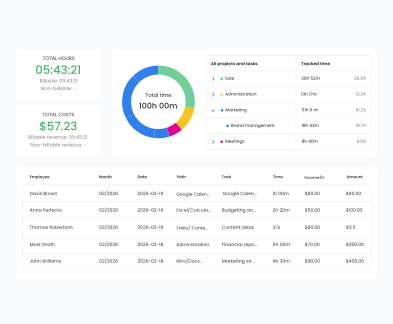
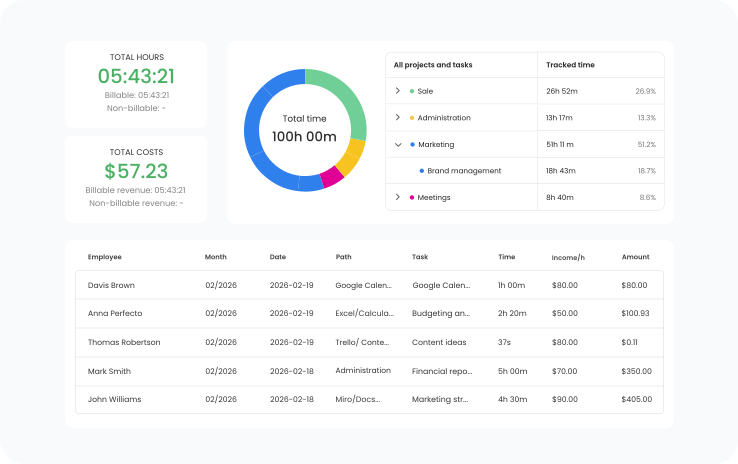
Fortunately, they came across TimeCamp: setup was easy and implementation went smoothly. They built project structures to track time per client or task, and custom views let managers see time per project and per staff member, so they could bill clients accurately.
What each team at Mirador gained

Data Scientists
automatic timer tracks the entire workday, even offline

Project Managers
meetings auto-sync from calendars to timesheets via Google Calendar

Client reporting
custom reports prepared in minutes, exportable in any format
Positive feedback
our best reward

 Google


